

July 2026 Economic and Investment Update:
The Year The Little Guy Took The Lead
The Year The Little Guy Took The Lead
Six months into 2026 and the market has already packed in a full year’s worth of plot twists: an oil shock, an inflation scare, a March swoon, fresh record highs — and, most delightfully unexpected of all, small-company stocks running laps around the giants. Here is what happened, why it happened, and what we are watching from here from our July 2026 economic and investment update.
The First Half in Review
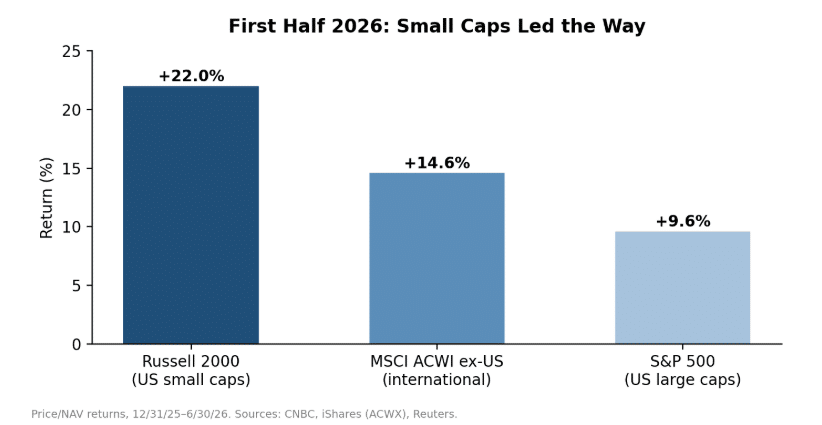
First, the scoreboard. The S&P 500 gained 9.6% in the first half (10.2% including dividends) and crossed 7,600 for the first time. The real headline, though, was written further down the size spectrum: the Russell 2000 index of smaller companies surged roughly 22%, and international stocks returned about 15%. Bonds, squeezed by rising yields, eked out barely positive returns. For once, the best-diversified portfolios were also the best-performing ones.
What Drove It?
In a word… earnings — and behind the earnings, artificial intelligence. First-quarter S&P 500 profits grew roughly 28% year over year on revenue growth near 12%, and about 85% of companies beat estimates, well above the five-year average of 78%. The AI build-out kept its title as the economy’s biggest growth engine, but 2026’s version is broader than last year’s: memory-chip makers, equipment suppliers, and power providers joined the party rather than watching a handful of mega-caps enjoy it alone. Energy was among the strongest sectors after the June conflict involving the U.S., Israel, and Iran sent oil prices sharply higher — a reminder that not every market driver this year came out of a data center.
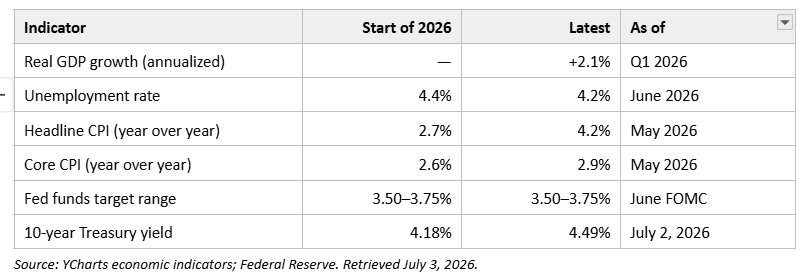
The economy, meanwhile, did its job without drama. GDP grew at a 2.1% annualized pace in the first quarter. Unemployment sat at 4.2% in June, and employers added more than 100,000 jobs a month for three straight months through May. The consumer kept spending. This is not a boom — it is something arguably better: a steady expansion with a powerful investment cycle layered on top.
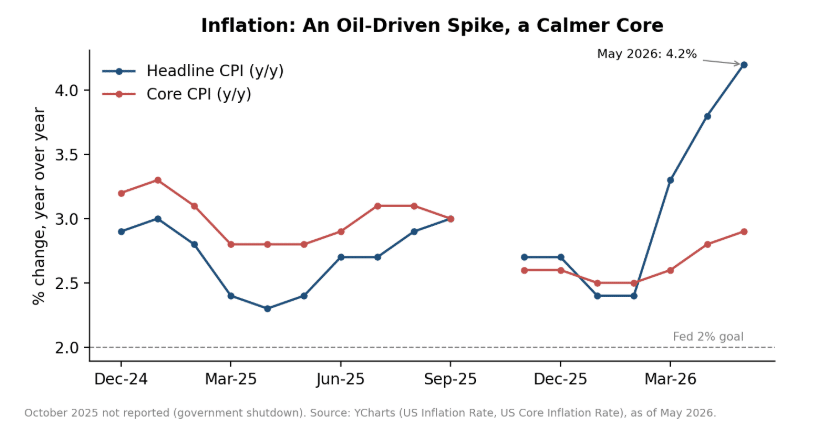
The blemish is inflation. Headline CPI jumped from 2.4% in February to 4.2% in May as the oil spike worked through gasoline and transport costs. The more telling number is core inflation (excluding food and energy), which rose only modestly to 2.9%. The Federal Reserve held rates at 3.50% – 3.75% in June, and markets that once expected one or two cuts this year have largely stopped expecting any. The 10-year Treasury yield rose from 4.18% to 4.49%, which is precisely why bond returns went nowhere.
Small Caps: Worth the Wait
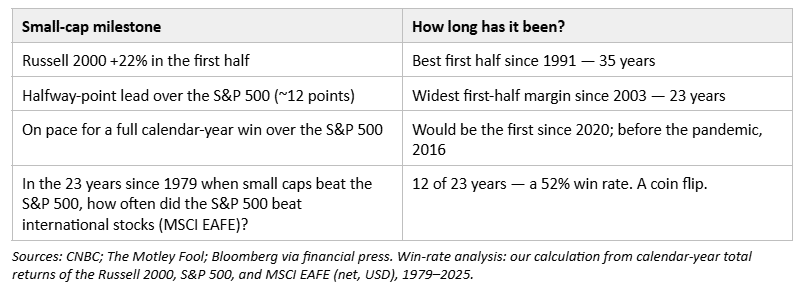
If you have been an investor for the past decade, you have heard the promise “small caps are due” so often it became a punchline. This year it finally landed. The Russell 2000’s 22% first-half gain is its best start to a year since 1991 — thirty-five years — and its lead over the S&P 500 at the halfway mark is the widest since 2003. If the advantage holds through December, it would be small caps’ first calendar-year win since 2020, and only their second since 2016.
Why now, after so many false dawns? Four reasons.
First, price: small caps entered 2026 at their largest valuation discount to large caps in roughly three decades and as one strategist memorably put it, it is hard to fall out of a basement window.
Second, geography: about 77% of small-cap revenue is earned at home, versus less than 60% for large caps, which insulated smaller firms from geopolitical crosswinds and a firming dollar.
Third, profits: consensus 2026 earnings-growth forecasts for Russell 2000 companies have climbed from about 23% at the start of the year to roughly 38%.
And fourth, the AI trade widened its circle — chip-related companies account for 16 of the Russell 2000’s 50 best performers this year, several of them up more than 400%. An honest caveat: roughly 40% of Russell 2000 companies are unprofitable, and rates that stay higher for longer bite hardest there.
We treat this rally with respect, not blind faith.
Now for a question we found genuinely fun to test: does small-cap leadership tell us anything about how U.S. stocks fare against the rest of the world? Intuition says yes — small caps leading feels like a vote of confidence in America.
History shrugs.
Since 1979 there have been 23 calendar years in which the Russell 2000 beat the S&P 500. In those years, the S&P 500 went on to beat international developed-market stocks (MSCI EAFE) just 12 times — a 52% win rate.
A coin flip.
Small-cap leadership is a statement about risk appetite, not about America versus everyone else. Fittingly, 2026 is proving the point in real time: international stocks are also ahead of the S&P 500 this year. Rising risk appetite has lifted many boats — the biggest U.S. companies simply happen to be the slowest ones at the moment.
Who Actually Moved the S&P 500
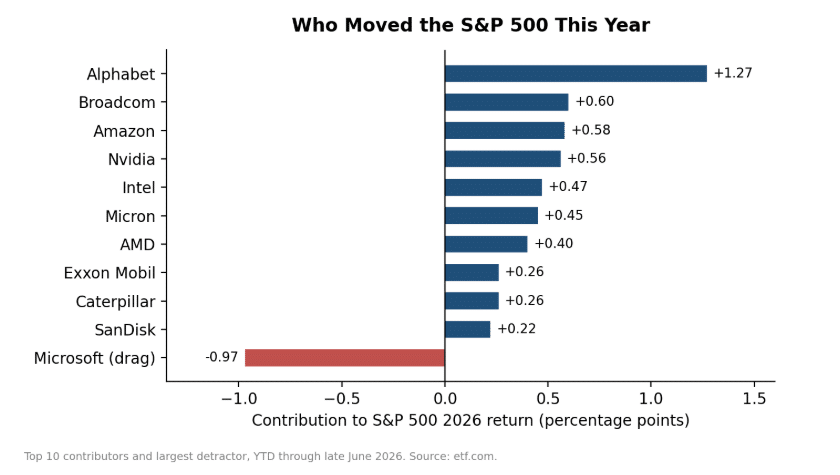
Peek under the index’s hood and the leadership looks refreshingly different from the past few years.
Alphabet has been the single biggest engine, contributing 1.27%, more than a fifth of the index’s gain. Broadcom, Amazon, and Nvidia follow. Notably, Nvidia’s contribution is roughly in line with its 7.7% index weight: still enormous, but no longer carrying the market on its back.
The scene-stealers are further down the list – Intel, up 156% this year, has contributed more from a 0.4% weight than most companies ten times its size, and memory-chip maker Micron is close behind.
The two top-15 contributors with no AI angle at all: Exxon Mobil, lifted by the oil spike, and Walmart. It has not been all sunshine — Microsoft has been the biggest drag, subtracting nearly a full percentage point, with Tesla, Eli Lilly, Meta, and Palantir also detracting. In all, the top ten names contributed 5.1 points — healthier breadth than 2025, but still a market where a handful of stories matter enormously.
What We Are Watching in the Second Half
- Inflation versus the Fed – The oil spike has so far stayed out of core inflation. If that holds, rate cuts come back on the table; if it seeps in, “higher for longer” gets longer.
- Oil and the Middle East – Energy has been both a top-performing sector and the chief inflation culprit. De-escalation would trade one tailwind for a better one.
- The AI capital-spending cycle – Nearly every major contributor to this year’s gains is tied to AI infrastructure. Order books remain full, but the market now needs the spending and eventually the profits to keep validating the prices.
- Small-cap staying power – With 40% of the Russell 2000 unprofitable, the rally’s durability depends on earnings delivery, not just enthusiasm.
- The midterm elections – Midterm years are historically choppy in the autumn and generous in the twelve months that follow. We would not be surprised by both.
The first half rewarded patience, diversification, and a strong stomach in March. We do not expect the second half to be quieter – markets rarely oblige – but portfolios positioned across company sizes and geographies were built for exactly this kind of year.
Thanks for tuning into out July 2026 economic and investment update. As always, if anything in your life or goals has changed, or you simply want to talk through any of the above, we would love to hear from you.
Sources
Market performance and drivers: CNBC (June 30, 2026); Hightower Advisors and Alexandria Capital mid-year reviews; Seeking Alpha; The Motley Fool (July 2, 2026). S&P 500 contributors: etf.com. Small-cap analysis: Carson Group (April 2026); LPL via CNBC; Goldman Sachs via Yahoo Finance. Economic data: YCharts (inflation, unemployment, GDP growth, Treasury yields, fed funds); Federal Reserve FOMC statements; Bureau of Labor Statistics. International returns: iShares (ACWX, six months ended June 30, 2026). Win-rate analysis: our calculation from published calendar-year index total returns, 1979–2025. Figures as of June 30, 2026 unless noted.
Disclaimer
Portus Wealth Advisors, LLC (“Portus”) is a registered investment adviser with the U.S. Securities and Exchange Commission (“SEC”). Registration with the SEC does not imply a certain level of skill or training and does not constitute endorsement by the SEC.
The information contained in this communication is for informational purposes only, is general in nature, and is not directed to any specific individual. It does not constitute investment advice, a recommendation, or an offer to buy or sell any security. Reading this communication does not create an advisory relationship with Portus.
The views and opinions expressed herein are those of Portus as of the date of publication and are subject to change without notice. Portus makes no representation that any opinion or projection will be realized. Information has been obtained from sources believed to be reliable; however, Portus does not warrant its accuracy, completeness, or timeliness.
Investing involves risk, including the possible loss of principal. Past performance is not indicative of future results. Different types of investments involve varying degrees of risk, and there can be no assurance that any specific strategy will be profitable or suitable for an investor’s individual circumstances. Investors should consult their own tax, legal, and financial professionals before making investment decisions.
