

May 2026 Economic and Investment Update: Why Investment Discipline
Matters Through Market Cycles
Matters Through Market Cycles
Disclaimer: The portfolio referenced below is a 60% equity / 40% fixed income model portfolio. The equity sleeve consists of a combination of individual securities, exchange-traded funds (ETFs), and mutual funds. Performance data shown reflects a representative account for the model and is intended for illustrative purposes only. Individual account performance may differ materially due to factors including, but not limited to, the timing of contributions or withdrawals, tax treatment, fees, and other client-specific circumstances. Past performance is not indicative of future results. Investing involves risk, including the possible loss of principal.
The past sixteen months have reinforced to the team why investment discipline matters more than short-term reactions. During this period, markets have cycled through an AI valuation reset, a Federal Reserve pivot, and two distinct tariff shock waves.
Through all of it, the moderate portfolio (60% equity and 40% fixed income) delivered +21.10% in cumulative total return before fees from January 1, 2025 through April 30, 2026, while the blended benchmark returned +21.72% over the same period.
A gap of roughly sixty basis points over sixteen months tells only part of the story.
What matters more is how it unfolded: underperformance concentrated in one sharp event window in early 2025, a steady recovery through the second half of the year, and a clear reversal in 2026 where the portfolio has outperformed by 194 basis points year-to-date through April 30.
H1 2025: When One Event Drives the Narrative
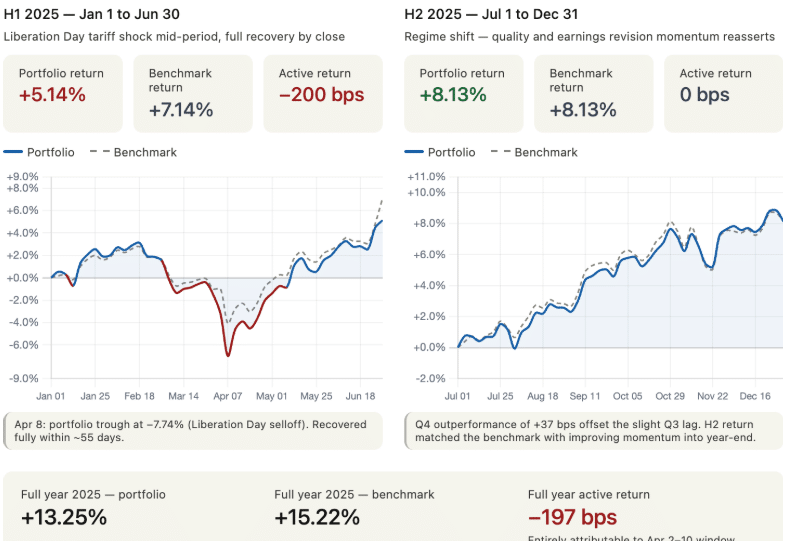
The first half of 2025 opened constructively. The portfolio reached a peak active return of +47 basis points (active return demonstrates either outperformance or underperformance relative to a benchmark) in mid-January, carried by strong earnings revision momentum across the technology and financial holdings. That lead proved difficult to hold once three distinct headwinds emerged.
Late January brought the DeepSeek shock (a China company making huge progress in AI without our advanced semiconductors) and a sudden intraday repricing of U.S. semiconductor and AI infrastructure names. Our meaningful exposure to AVGO, NVDA, and LRCX absorbed more of that volatility than the blended benchmark, whose more global diversification buffers against single-theme concentration and US underperformance.
February and March were defined by tariff anxiety and a growth-to-value rotation. Quality large-company compounders, the core of our stock selection framework, lagged during this rotation. The portfolio finished March down roughly 2.95% for the month against the benchmark’s 2.54% decline.
Then came April 2, 2025.
The announcement of broad reciprocal tariffs, Liberation Day, triggered the sharpest single-event dislocation of the year. The portfolio fell approximately 3.2% on April 3 and reached a cumulative YTD low of -7.74% on April 8.
Once again, the benchmark’s blended structure provided better downside protection than our portfolios.
By June 30, the portfolio had fully recovered and was posting +5.14% for the 1st half against the benchmark’s +7.14%.
Q3 and Q4 2025: The Regime Shift
Q3 was a period of stabilization. Markets digested the tariff developments, the Fed signaled a potential easing path, and sentiment normalized.
The portfolio advanced +5.11% against the benchmark’s +5.58%, with international equity markets continuing to outperform in a way that benefited the benchmark’s ACWI weight more than our positioning.
What changed meaningfully in Q4 was the underlying market regime. Investor attention moved away from policy volatility and back toward earnings fundamentals.
Quality and earnings revision momentum, the core of our stock selection process, began reasserting itself as the dominant return driver.
October delivered +27 basis points of active return, November added +31 basis points, and the full quarter generated +37 basis points of outperformance.
Full-year 2025 finished at +13.25% for the portfolio versus +15.22% for the benchmark – a disappointing gap.
But honestly it was one we felt we had positioned the portfolio to recover from with deliberate changes throughout H2 2025.
Positions where the original thesis had played out or where earnings revision momentum was deteriorating were sold.
We incrementally built international equity exposure through quality-factor managers with global mandates, improving benchmark alignment without abandoning our high-conviction approach to U.S. large-cap selection.
2026 YTD through April 30: The Positioning Pays Off
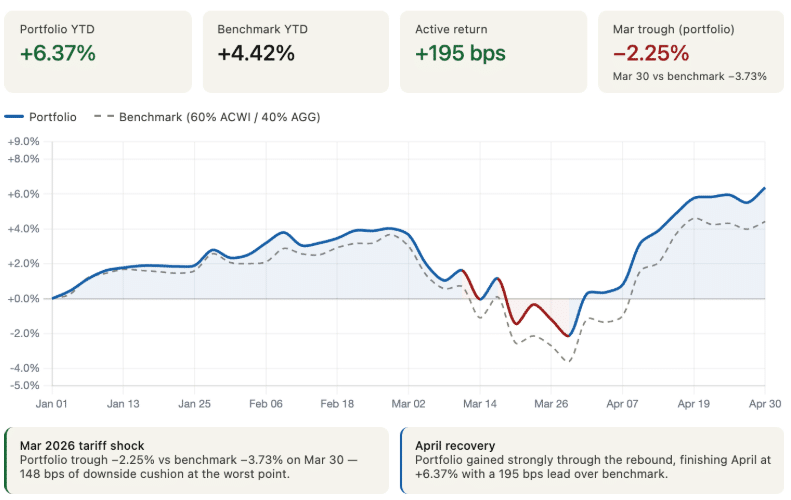
The dynamic that began in Q4 2025 accelerated sharply in 2026. From January 1 through April 30, the portfolio returned +6.37% against the benchmark’s +4.43%, generating 1.94% of active return in four months.
The standout period was March 2026. A new wave of tariff announcements triggered a broad selloff.
The benchmark fell approximately 6.09% during the month. The portfolio declined only 4.28%, outperforming by 1.81% in a single month.
At the trough on March 30, the portfolio drawdown was -2.25% from the January start while the benchmark had fallen -3.73%, a 1.48% cushion at the worst point of the shock.
That defensiveness was not accidental. Our emphasis on companies with strong pricing power, durable free cash flow, and lower international revenue exposure delivered exactly the downside protection the quality thesis promises in a risk-off environment.
The fixed income and structured note positions also contributed.
Alongside traditional investment-grade credit and diversified bond funds, the portfolio holds structured income notes. These instruments generated incremental income and excess return during a period when conventional fixed income was navigating renewed interest rate risk – which provided better returns than traditional fixed income.
April brought a strong recovery as trade negotiation signals improved.
The portfolio gained +6.09% against the benchmark’s +5.60%, sustaining the active return lead through the rebound and finishing the month with a 1.94% point advantage for the year (for the year through April 30).
Technology infrastructure, financial services, and defense-oriented industrials were among the strongest equity contributors. Commodity-linked positions and healthcare names with EPS revision headwinds were modest detractors, consistent with broader sector dynamics under ongoing trade policy uncertainty.
Our Process: Why We Don’t Chase Inflection Points
The question we receive most often during periods of short-term underperformance is some version of why we didn’t reduce risk ahead of the selloff. It deserves a direct answer.
We manage portfolios around three anchors.
First, we focus on sustainable themes with multi-year earnings growth visibility, not quarterly sentiment cycles.
Second, we believe that frequent repositioning in response to short-term signals generates transaction costs, tax drag, and timing errors that compound against long-term returns.
Third, the moments when it feels most urgent to act are often the moments when patience is most rewarded.
The Liberation Day example is instructive. On April 3, 2025, with the portfolio down sharply and headlines at peak alarm, the pressure to de-risk was real.
The benchmark looked more resilient.
But within two months markets had recovered, the earnings revision momentum we track across holdings remained intact, and the portfolio had fully recaptured its losses.
A portfolio repositioned in April would have crystallized losses and very likely missed the recovery.
The March 2026 episode reinforces the same point from the other direction. Simply because we did not overreact to the first shock, the portfolio was properly positioned to absorb the second one with less damage than the benchmark.
Current Portfolio Construction
The portfolio today maintains a concentrated equity sleeve of high-conviction U.S. large-cap names alongside diversified exposure through equity ETFs and mutual funds spanning U.S. growth, international developed, and global quality factors.
Individual equity names share a common thread: positive or accelerating forward EPS revisions, durable balance sheets, and a demonstrable track record of capital allocation discipline. Cyclical and commodity-linked exposures are held at deliberate underweights given ongoing trade policy uncertainty.
The fixed income allocation, representing approximately 38% of the portfolio, is positioned across short-duration investment-grade credit, diversified bond funds, municipal structures, and structured notes.
The structured note position is a deliberate way to generate high income with lots of downside protection. It should perform very well in today’s markets of higher volatility and inflation scares.
On the international side, increased allocations to quality-factor global managers have improved benchmark alignment and provided a more balanced risk profile.
Looking Ahead
We remain constructive on the portfolio’s positioning for the remainder of 2026. The themes we identified entering the year, quality compounders with durable earnings growth, financial sector beneficiaries of a normalizing rate environment, and technology infrastructure exposed to the secular AI build-out, have proven resilient through significant macro volatility.
The 1.94% of active return generated YTD through April 30 reflects genuine fundamental differentiation, not style drift or concentrated bets on a single outcome.
Risks we are monitoring include further trade policy escalation and its second-order effects on corporate margins, the pace of Federal Reserve normalization, and any sustained deterioration in the EPS revision breadth we track across holdings.
We have not seen the latter materialize meaningfully. If we do, our process would prompt a reassessment of individual position sizing.
The past sixteen months validated the value of patience and process discipline. And that’s our commitment, as always.
Another Disclaimer
Portus Wealth Advisors, LLC (“Portus”) is a registered investment adviser with the U.S. Securities and Exchange Commission (“SEC”). Registration with the SEC does not imply a certain level of skill or training and does not constitute endorsement by the SEC.
The information contained in this communication is for informational purposes only, is general in nature, and is not directed to any specific individual. It does not constitute investment advice, a recommendation, or an offer to buy or sell any security. Reading this communication does not create an advisory relationship with Portus.
The views and opinions expressed herein are those of Portus as of the date of publication and are subject to change without notice. Portus makes no representation that any opinion or projection will be realized. Information has been obtained from sources believed to be reliable; however, Portus does not warrant its accuracy, completeness, or timeliness.
Investing involves risk, including the possible loss of principal. Past performance is not indicative of future results. Different types of investments involve varying degrees of risk, and there can be no assurance that any specific strategy will be profitable or suitable for an investor’s individual circumstances. Investors should consult their own tax, legal, and financial professionals before making investment decisions.
